Architected and deployed a full-stack B2B e-commerce platform supporting a catalog of 800 active SKUs, enabling the client to digitize sales and scale catalog operations.
Led migration with Server-Side Rendering (SSR), improving Core Web Vitals and driving top-tier Google rankings, increasing organic discoverability against competitors.
Optimized product discoverability by implementing advanced search capabilities, reducing search query latency by 97% (from 700ms to 20ms) and enabling instant, typo-tolerant filtering for the B2B catalog.
Languages:Typescript
Frontend:Next.js
Backend:StrapiMeilisearch
Services:Stripe

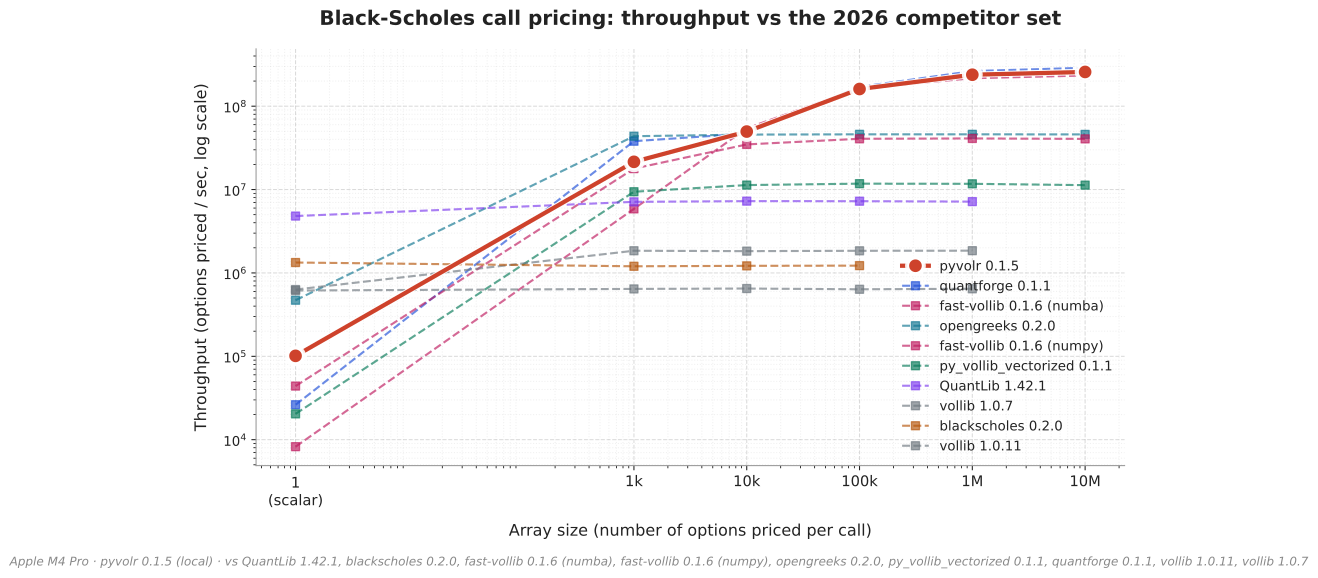
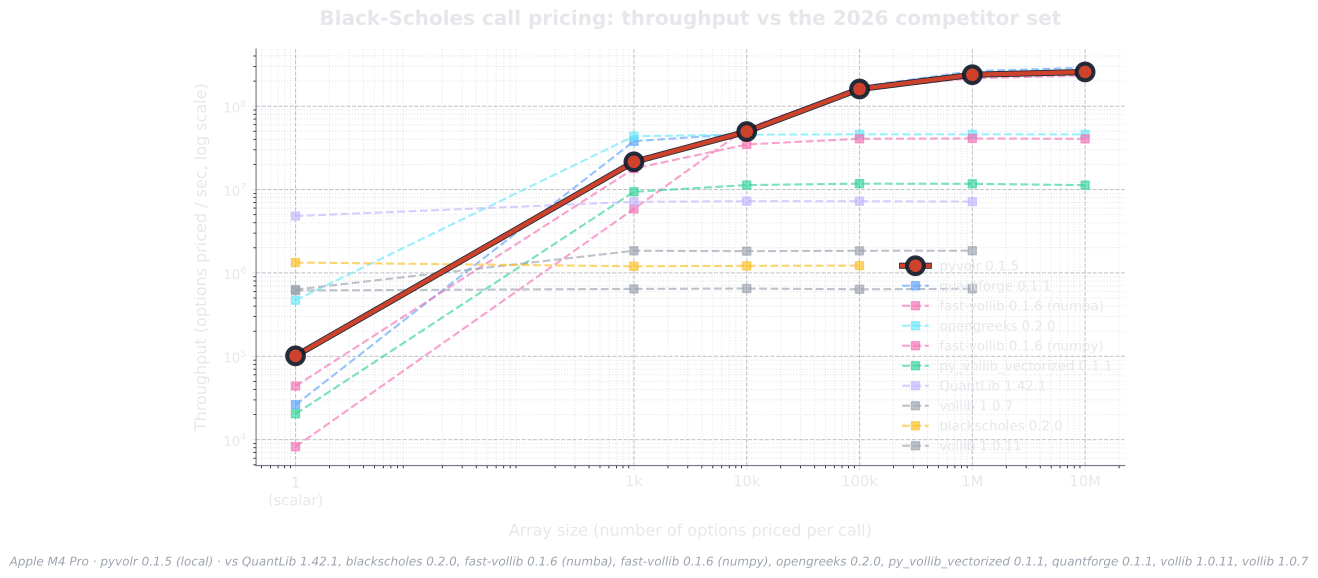
Throughput vs the active BSM ecosystem (log-log, by array size)Implied-vol accuracy deep in the tail (correct digits, higher is better)
pyvolr
A modern Python library for Black-Scholes-Merton pricing, Greeks, and implied volatility — a Rust core, fully vectorized over NumPy, and drop-in compatible with `py_vollib`/`vollib`. Built to be the fast path for the active BSM ecosystem while staying f64-exact deep in the tails, where faster rivals silently break.
Built a Rust numerical core — BSM and Black-76 pricing, all five Greeks, and a Manaster-Koehler-seeded Newton-Raphson implied-vol solver with bisection fallback — exposed to Python via PyO3 and parallelized with rayon above per-endpoint thresholds. It leads the active ecosystem at scale: 1M implied-vol solves land ~2× faster than fast-vollib's numba backend and ~12× faster than opengreeks, and the parallel price path prices 1M strikes in ~4 ms — all while preserving scalar-in/scalar-out ergonomics down to a sub-microsecond scalar fast path.
Made tail correctness the differentiator: an `erfcx`-based normal CDF and a normalized-Black forward map keep implied vols f64-exact down to option prices of 1e-215, where every fast 2026 entrant (fast-vollib, opengreeks, quantforge) starts returning silently-wrong constant volatilities between prices of ~1e-6 and ~1e-26 — pinned against an mpmath golden ladder and cross-checked to ~1e-13 against every competitor on well-posed inputs.
Shipped a sustainability-first release pipeline — release-please with PyPI Trusted Publishing (OIDC, no stored credentials), differential tests to catch numerical drift, and a Python 3.10–3.14 × Linux/macOS/Windows wheel matrix plus a free-threaded 3.14t build — alongside drop-in `pyvolr.compat.py_vollib` and `py_vollib_vectorized` shims that let existing users migrate with a single import-line change.
Languages:RustPython
Other:PyO3NumPymaturin
Secrets Spotter
An open-source CLI and Chrome extension that detects exposed secrets in files, directories, stdin, web pages, and network traffic — powered by a shared Rust core.
Built a unified Rust detection engine with 50 patterns (AWS, GitHub, Stripe, JWTs, private keys, and more) plus false-positive filtering via Shannon entropy, character-class diversity, and code-identifier rejection — shared across the CLI and browser extension from a single core.
Shipped a CI/CD-ready CLI with SARIF output for GitHub Code Scanning, JSON mode for automation, and glob and severity filters, enabling drop-in secret scanning across files, directories, and stdin pipelines.
Engineered a WASM-powered Chrome extension that scans DOM content and intercepts fetch, XHR, WebSocket, SSE, and cookies through a MAIN-world interceptor, with SHA-256 deduplication and automatic re-scan on SPA navigations — all fully local.